
In a dark history of failed institutions, this study highlights the moral agency individuals of different religious backgrounds exercised, making conscious choices to help or refuse to harm targeted Tutsi, even at great personal risk. The study shows the importance of a trusted community and cohesive social network in survival and resilience during mass violence.
Respondents who were targeted to be killed reported the types and manner of help they received during the Genocide, with a comparison between respondents who were Jehovah’s Witnesses during the Genocide and those who were non-JWs in 1994. Although being a small and vulnerable group, Jehovah’s Witnesses had the advantage of having a social and religious network solidified during the decade of religious persecution prior to the Genocide. The following are key findings of helping behaviors during the Genocide:
- Results show that 80% of targeted Jehovah’s Witnesses received help from baptized believers or others associated with the faith community. Additionally, 21% of targeted non-JWs reported receiving help from those in the small faith community of Jehovah’s Witnesses.
- Targeted Jehovah’s Witnesses received more help than non-JWs received. Of the Witnesses, 50% were hidden by others, 47% received food/supplies, 41% were warned of danger, and 35% reported helpers who risked their lives.
- JW helpers were more likely to coordinate help with a network of support; 20% of targeted Jehovah’s Witnesses received help from over 15 people, even when in danger for longer periods.
- Nearly 30 years later, almost two thirds (63%) of those who were Jehovah’s Witnesses during the Genocide remained in contact with those who helped them survive. Thus, rescue experiences would become part of the community’s collective memory and identity, further fostering a sense of belonging and mutual support. (Figure 5.20)
Figure 5.20, Types of Help Received During the Genocide – Targeted Jehovah’s Witnesses and Non-JWs
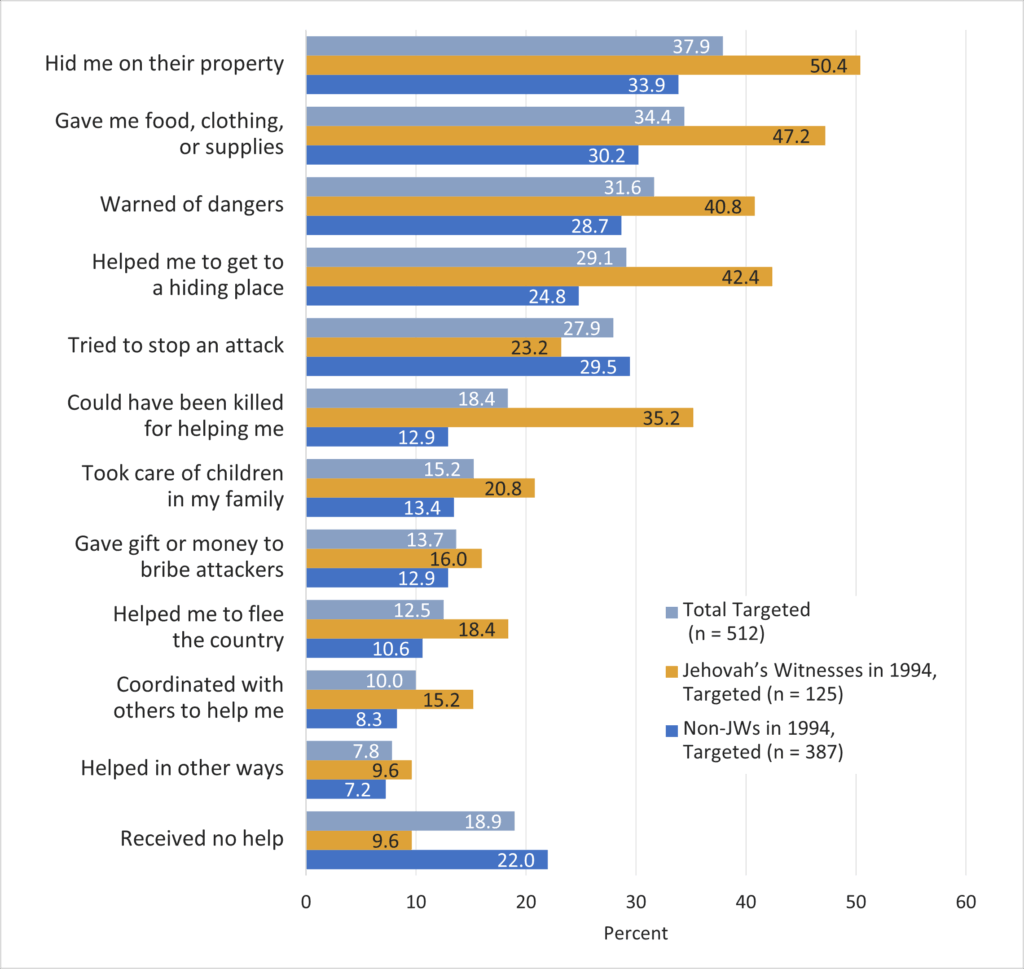
Chart Summary
The horizontal bar chart compares percentages for 12 types of help received by targeted individuals (n = 512) during the 1994 genocide: Jehovah’s Witnesses who were targeted (n = 125) and non-Witnesses who were targeted (n = 387). For each of the 12 types of help received, the following percentages are reported by the total targeted sample, and broken down by targeted Witnesses, and targeted non-Witnesses:
- Being hidden on someone’s property (among the highest categories reporting receiving help) shows 37.9% for the total, 50.4% for Witnesses, and 33.9% for non-Witnesses.
- Being given food, clothing, or supplies (also at strong levels) shows 34.4% for the total, 47.2% for Witnesses, and 30.2% for non-Witnesses.
- Warned of danger appears at 31.6% for the total, 40.8% for Witnesses, and 28.7% for non-Witnesses.
- Help reaching a hiding place shows similar patterns as warning of danger (29.1% for the total, 42.4% for Witnesses, and 24.8% for non-Witnesses).
- Trying to stop an attack appears at 27.9% for the total, 23.2% for Witnesses, and 29.5% for non-Witnesses.
- Risk incurred by helpers (could have been killed for helping me) is 18.4% for the total, and notably higher for Witnesses at 35.2% compared with 12.9% for non-Witnesses.
- Childcare assistance appears at 13.4% for non-Witnesses, 20.8% for Witnesses, and 15.2% for the total targeted.
- Giving money or gift to bribe attackers shows 13.7% for the total, 16.0% for Witnesses with 12.9% for non-Witnesses.
- Help fleeing the country appears at 12.5% calculated for the total, 18.4% for Witnesses, with 10.6% for non-Witnesses.
- Coordinated helping assistance displays at 10.0% for the total, 15.2% for Witnesses, and 8.3% for non-Witnesses.
- Other help received appears at 7.8% for the total, 9.6% for Witnesses, with 7.2% for non-Witnesses.
- And percentages for those who reported receiving no help displayed a total targeted at 18.9%, Witnesses at 9.6%, and notably larger at 22.0% for non-Witnesses.
These findings appear in Section 5 of the report.