
Those who were minors during the Genocide remember having performed practical tasks to help their family (fetching water, food, and supplies), making difficult decisions without adult supervision, and sometimes making things difficult for parents. In contrast, parents during the Genocide positively recalled their children as being cooperative and remaining quiet to avoid detection, caring for other children, and being a motivation not to give up. (Figure 5.19)
Figure 5.19, Children’s Role During the Genocide as Recalled by Parents and Children
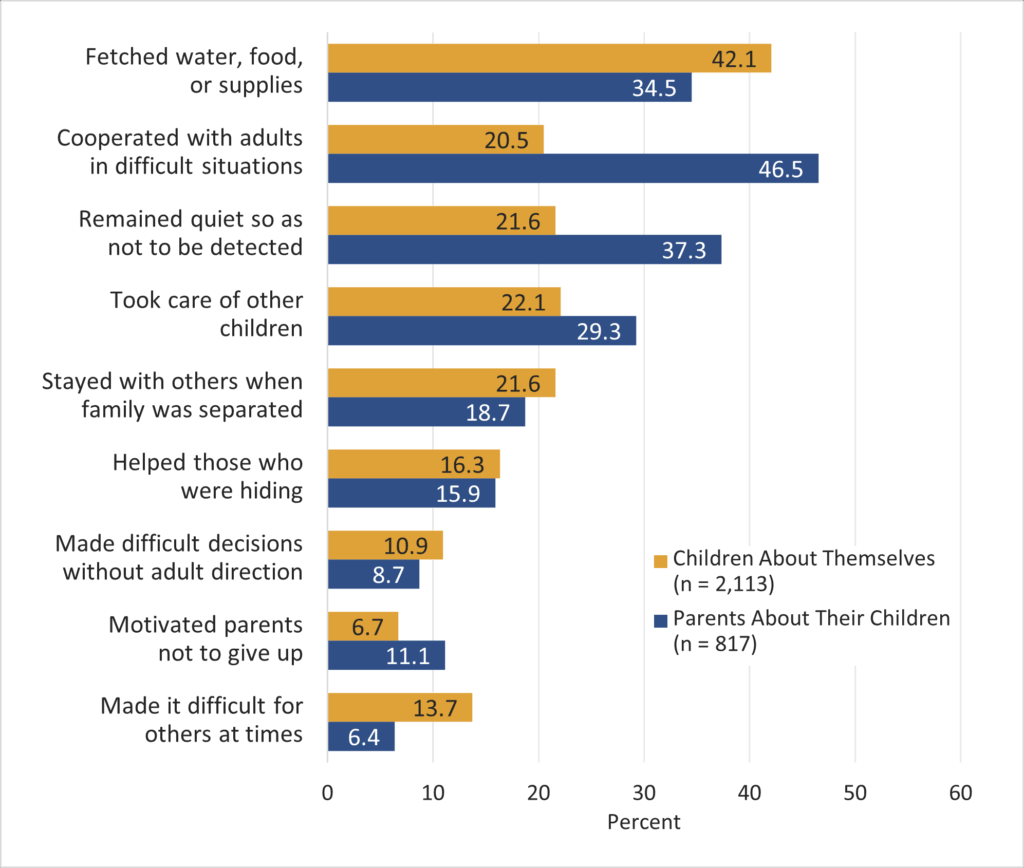
Chart Summary
The horizontal bar chart compares percentages for 9 roles of children during the genocide, reported by 2 groups: children describing their own experiences (n = 2,113) and parents describing their children’s experiences (n = 817). This allows contrasts in recall between children and parental reports.
- Fetching water, food, or supplies is highest for both reporting groups (42.1% by children, 34.5% by their parents).
- Cooperating with adults in difficult situations shows a large difference (20.5% reported by children versus 46.5% reported by their parents).
- Remaining quiet to avoid detection is reported at 21.6% by children about themselves and 37.3% by their parents.
- Taking care of other children appears at 22.1% as children reported and 29.3% as parent reported.
- Staying with others when the family was separated shows moderate levels (21.6% by children and 18.7% by parents).
- Helping those who were hiding is similar across both groups (16.3% reported by children versus 15.9% by parents).
- Difficult decisions without adult direction is low but visible at 10.9% from children and 8.7% from parents’ reports).
- And motivating parents not to give up shows lower percentages (6.7% from children and 11.1% from parents).
- The smallest category, making things difficult for others at times, is shown as 13.7% reported by children themselves and 6.45% reported by their parents.
These findings appear in Section 5 of the report.