
Reasons to learn more about a religion and to remain in a religion are not always the same. Jehovah’s Witnesses in Rwanda indicated that they were initially attracted to Jehovah’s Witnesses because of the logic of the main teachings (49%) and the desire to learn more about the Bible (45%). The current attraction (or motivation) to remain in the faith prioritizes the desire to be closer to God (45%) and have a hope for the future (44%). Those who were attracted to the faith’s clear moral guidelines increased over time from original to current attraction (from 16% to 25%). Having Jehovah’s Witness family was an initial attraction to the faith for some, but familial connection drops significantly as a reason to remain in the faith (from 18% to 5%). (Figure 3.4)
Figure 3.4, Original and Current Attractions to Jehovah’s Witnesses
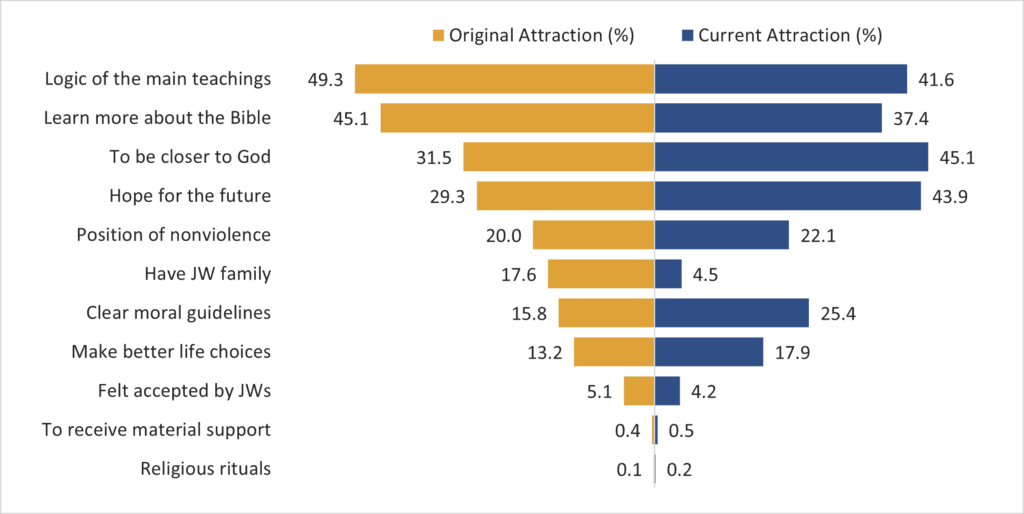
Chart Summary
The chart presents horizontal bars comparing percentages for original attraction versus current attraction to Jehovah’s Witnesses across 11 motivations, with original and current attraction each on its own percentage scale. The strongest original attractions are the logic of the teachings at 49.3% and learning more about the Bible at 45.1%, whereas current attraction is highest for closeness to God at 45.1% and hope for the future at 43.9%. Several attractions show increases over time. They include:
- Clear moral guidelines, from 15.8% originally to 25.4% currently.
- Making better life choices, from 13.2% originally to 17.9% currently.
- Closeness to God, from 31.5% originally to 45.1% currently.
- And hope for the future, from 29.3% as an original attraction to 43.9% as a current attraction, all of which show clear upward shifts.
Other categories remain relatively level or decline, such as the Witnesses position of nonviolence, which rises modestly from 20.0% to 22.1%. Having JW family as an original attraction drops sharply from 17.6% to 4.5% as a current attraction. Motivations chosen the least often as either original or current were those attracted in order to receive material support and those attracted to religious rituals, both at a half percent or less. These findings appear in Section 3 of the report.