
Jehovah’s Witnesses are neither a colonially established religion nor a newly established post-Genocide religion in Rwanda but rather date back to more than two decades before the Genocide. Despite repression during the government ban between 1982 and 1992, the faith community grew slowly but steadily. The number of baptized Witnesses increased dramatically after the Genocide in 1994—an increase of about 100% by 1996 and 1,600% by 2023. (Growth Over Time—Generations of Jehovah’s Witnesses in Section 5, Faith, page 98; Figure 3.2)
Figure 3.2, Number of Baptisms per Year, With JW and Non-JW Parents at Time of Respondents’ Birth
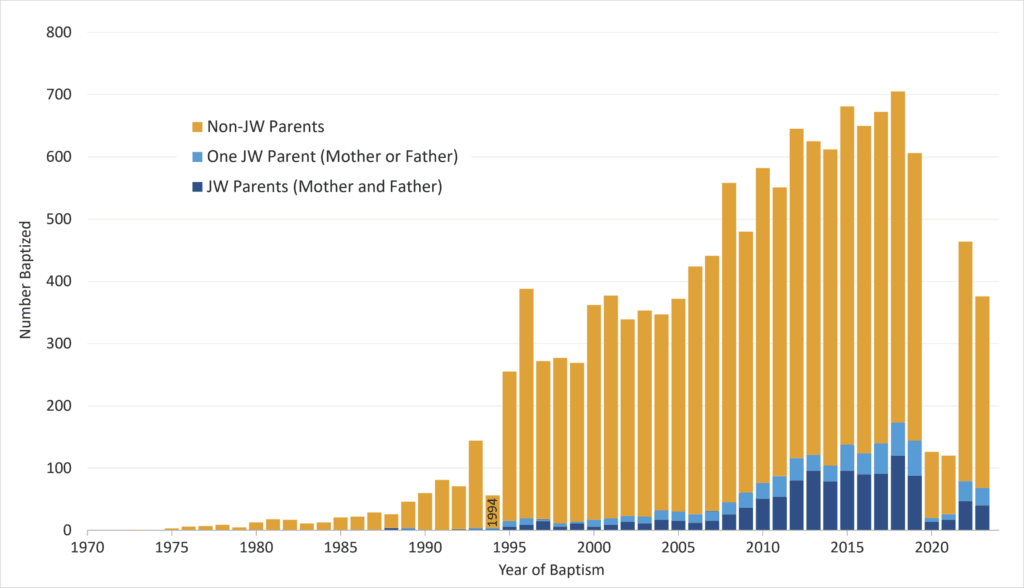
Chart Summary
The 3 categories of respondents’ parents’ religious affiliation displayed on the vertical bar chart include those whose parents were not Jehovah’s Witnesses, those with 1 J.W. parent, and those with 2 J.W. parents. The chart shows the number of respondents baptized each year between 1970 and 2023. The vertical axis ranges from 0 to 800 baptisms, and the horizontal axis lists the year of baptism. Each year displays the proportion of those baptized having either one or two Witness parents as well as the larger number who were adult converts. From the 1970s through late 1980s, total baptisms remain low with bars composed almost entirely of those whose parents were not Jehovah’s Witnesses. Beginning in the early 1990s, baptisms rise sharply, reaching peaks between roughly 2010 and 2018 with about 580 to 700 baptisms per year. During these years, the non-Witness parent group still dominates, but with visible increases in the 1 parent and 2 parent Witness segments, especially after 2008. After 2018, total baptisms begin to decline, with pronounced drops during 2020 and 2021, coinciding with the COVID 19 pandemic. Sharp increases are then seen in 2022 and 2023. These findings appear in Section 3 of the report.