
Jehovah’s Witnesses have a strong social identification with their faith community, with over 97% expressing commitment and satisfaction. Even among the 10% of respondents who had stopped associating with the congregation for a period, almost two thirds of these became active congregants again within two years. (Figure 3.12; Figure 3.13)
Nearly 95% of Jehovah’s Witnesses exhibit predominantly intrinsic religious motivations—a self-motivated commitment to one’s faith as a core value that provides meaning and guides behavior. Personal extrinsic benefits (happiness, comfort) and social motivations (making friends) are present but less important. (Figure 3.14)
Figure 3.12, Self-Identification With Jehovah’s Witnesses
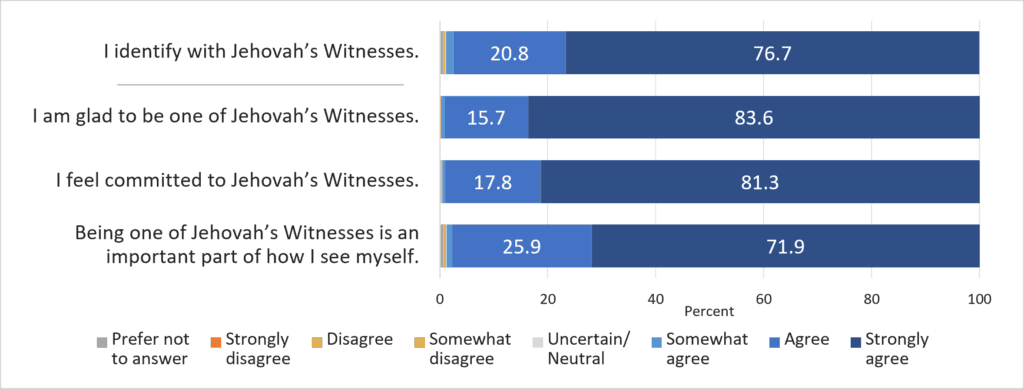
Chart Summary
The stacked horizontal bar chart shows percentages of responses to 8 options in 4 self-identification statements about being one of Jehovah’s Witnesses. Combining strongly agree and agree responses, 97.5% agree that they identify with Jehovah’s Witnesses. A total of 99.3% agree that they are glad to be Jehovah’s Witnesses, with 99.1% agreeing they feel committed to the Witnesses. More than 97% agree that being a Jehovah’s Witness is an important part of their self-identity. Disagreement, neutrality, and prefer not to answer options were very small across all 4 items. These findings appear in Section 3 of the report.
Figure 3.13, Length of Interrupted Association
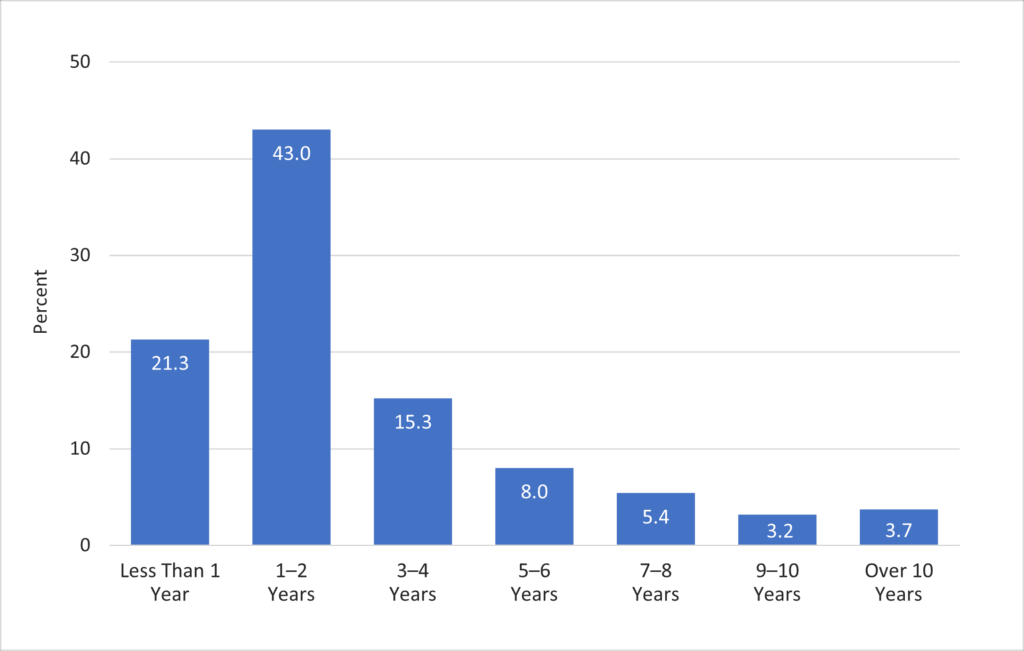
Chart Summary
The vertical bar chart shows 7 duration categories and the percentages of respondents who resumed association with Jehovah’s Witnesses after a period of interruption. The chart allows for comparison of association interruption lengths before returning to the congregation. For the dominant category of 1 to 2 years, 43% reported they had resumed association within this timeframe. This is followed by 21.3% reporting they resumed their association in less than 1 year. An interruption of 3 to 4 years was reported by 15.3% of respondents. Smaller segments show longer ranges of time before reassociating: 8.0% had been away for 5 to 6 years and 5.4% for 7 to 8 years. Approximately 3.2% resumed association within 9 to 10 years. Some 3.7% indicated that they had returned to the congregation after more than 10 years away. These findings appear in Section 3 of the report.
Figure 3.14, Religious Orientation: Intrinsic, Extrinsic-Personal, and Extrinsic-Social
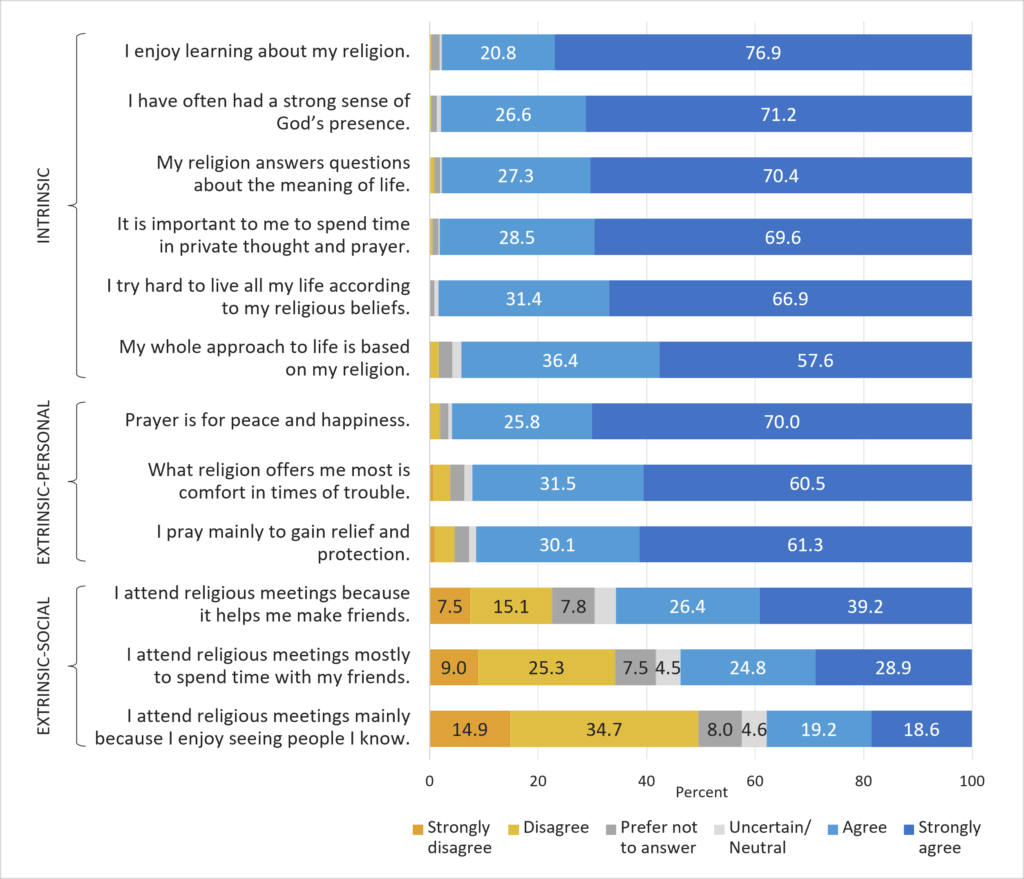
Chart Summary
The chart presents stacked horizontal bars showing percentages of responses to 12 items related to religious orientation, grouped into 3 orientation categories: Intrinsic, Extrinsic-Personal, and Extrinsic-Social. The 6 response options for each of these include strongly disagree, disagree, prefer not to answer, uncertain or neutral, agree, and strongly agree, stacked to 100%. Combining disagree and strongly disagree together, and combining agree and strongly agree together, between 94 and 98% agree with all 6 statements related to Intrinsic religious orientation: enjoy learning about religion, sense God’s presence, find answers to the meaning of life, value private thought and prayer, try to live life according to religious beliefs, and base one’s approach to life on religion. Likewise for the 3 statements under Extrinsic-Personal orientation, about 91 to 96% agree that prayer is for peace and happiness, religion offers comfort, and one prays mainly for relief and protection. In contrast, responses to the 3 Extrinsic-Social statements are more varied responses:
- 22.6% disagree that they attend meetings mainly to make friends, while 65.6% agree with the statement.
- 34.3% disagree that they attend primarily to spend time with friends, while 53.7% agree with the statement.
- And finally, almost half (49.6%) disagree that they attend meetings mainly because they enjoy seeing people they know, while 37.8% agree with this reason.
For each of these 3 items, approximately 8% preferred not to answer. These findings appear in Section 3 of the report.