
Congregations offer vital emotional and spiritual support that, in turn, fosters forgiveness, prosocial behavior, reconciliation, and social integration. About 90% of respondents view their Jehovah’s Witness congregation as a reliable source of support during difficult times such as natural disasters and personal crises. Resilience and support from their congregation comes through interpersonal bonds, integration of members, and emotional and practical care. (Figure 4.7)
Congregants are both givers and recipients of spiritual, emotional, and practical care. (Figure 4.8)
Figure 4.7, Community Resilience and Support Scale, Percentages of Responses by Item
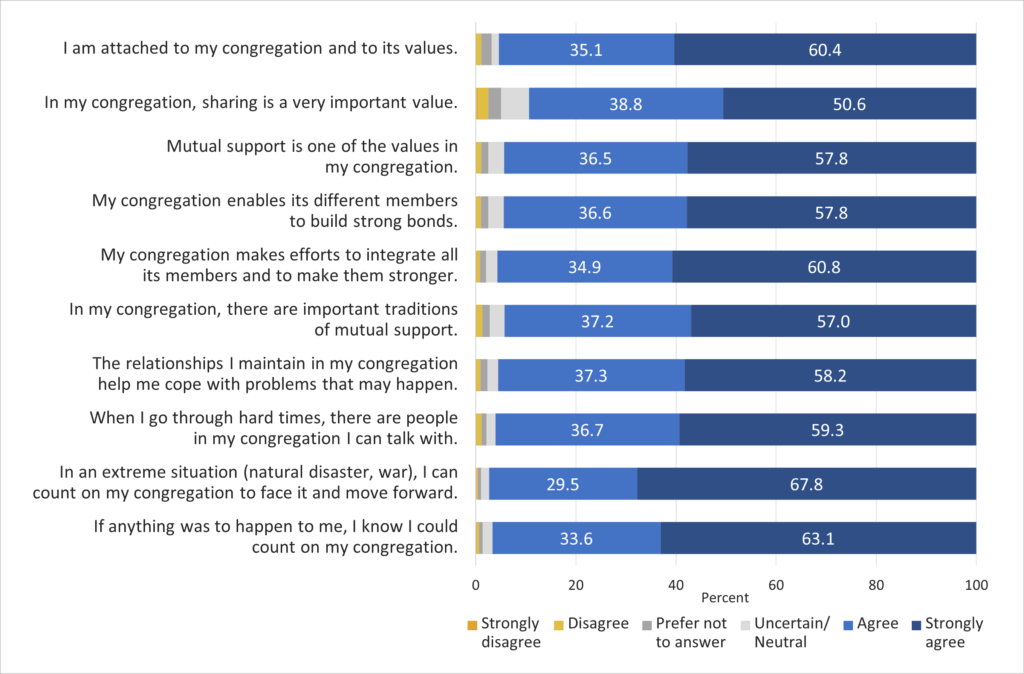
Chart Summary
The chart presents stacked horizontal bars showing percentages for 10 items from the Community Resilience and Support Scale, each segmented into 6 response categories: strongly disagree, disagree, prefer not to answer, uncertain or neutral, agree, and strongly agree. All 10 items show strong agreement of the respondents’ view that their congregations provide reliable support. For the 10 items, agreement ranges from 29.5% to 38.8%. Strongly agree responses range from 50.6% to 67.8%, with the highest percentage agreeing with the statement regarding reliable congregational support and help during extreme situations, such as wartime and natural disasters.
Combining agree and strongly agree responses, the following percentages are calculated for each item listed in the chart:
- 95.5% agree with the statement: I am attached to my congregation and its values.
- 89.4% agree that sharing is an important congregational value.
- 94.3% agree that mutual support is valued in their congregation.
- 94.4% agree that their congregation enables its members to build strong bonds.
- 95.7% agree that their congregation makes efforts to integrate all members to make them stronger.
- 94.2% agree that important traditions of mutual support exist in their congregation.
- 95.5% agree that maintaining relationships in their congregation helps them cope with problems.
- 96.0% agree that they receive emotional support through hard times from people in their congregation.
- 97.3% agree that during hard times such as wars or natural disasters, they can count on their congregation to support and help them to move forward.
- And finally, 96.7% agree that if anything were to happen to them, they could count on their congregation.
Disagreement, neutrality, and prefer not to answer bar segments were very small across all items. These findings appear in Section 4 of the report.
Figure 4.8, Giving and Receiving Help Among Jehovah’s Witnesses
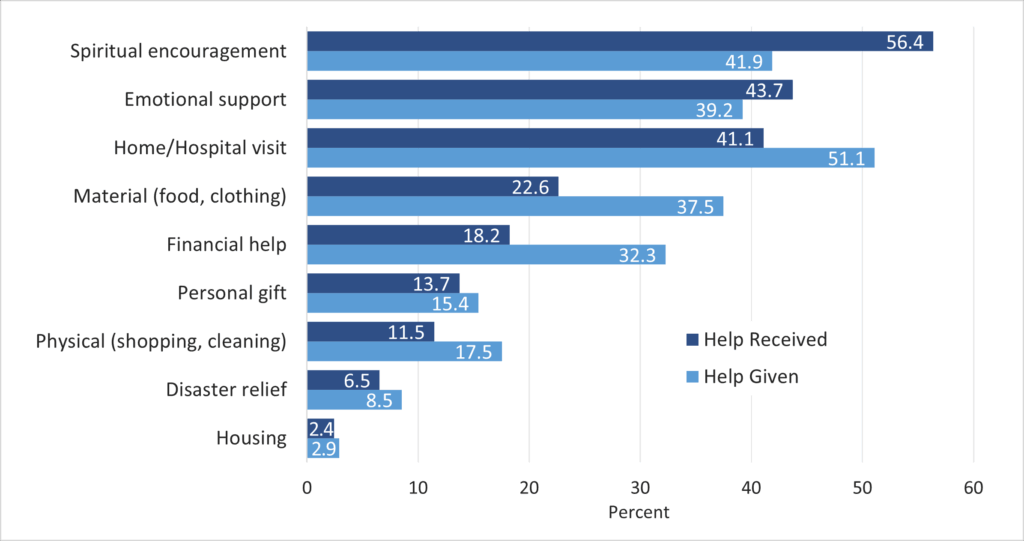
Chart Summary
The chart displays paired horizontal bars comparing percentages for 9 types of help received and help given among respondents who reported both behaviors, with values shown along a 0 to 60% scale. Spiritual encouragement is the most common help received at 56.4%, while 41.9% report giving it; emotional support follows with 43.7% received and 39.2% given. Home or hospital visits show 41.1% received and 51.1% given, one of the 7 categories where giving exceeds receiving. Material help (food, clothing) appears at 22.6% received and 37.5% given; financial help at 18.2% received and 32.3% given; personal gifts at 13.7% received and 15.4% given; and physical help such as shopping or cleaning at 11.5% received and 17.5% given. Disaster relief shows 6.5% received and 8.5% given. Housing is the smallest category at 2.4% received and 2.9% given. These findings appear in Section 4 of the report.