
Results show that strong compassion toward others, especially strangers in need, is widely internalized in the community. Older adults and those who lived through the Genocide or were returnees after the Genocide scored higher than the Post-Genocide Generation, suggesting life experience may deepen compassion. (Figure 4.4)
Figure 4.4, Compassionate Love for Humanity, Percentages of Responses by Item
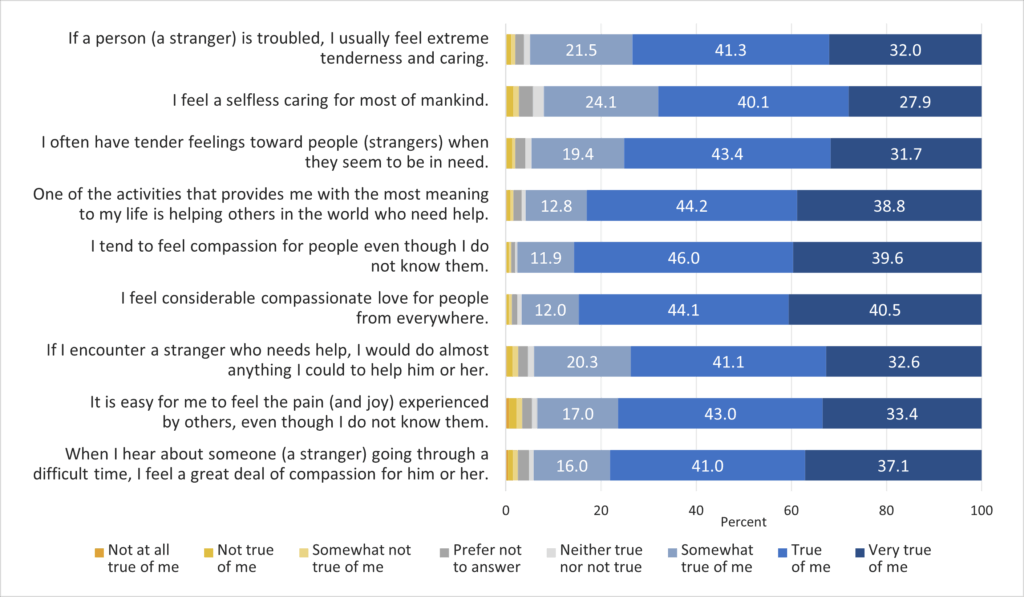
Chart Summary
The chart presents stacked horizontal bars showing percentages of responses to 9 items from the Compassionate Love Scale for Humanity (short version), with response options of not at all true of me, not true of me, somewhat not true of me, prefer not to answer, neither true nor not true, somewhat true of me, true of me, and very true of me, stacked to 100%. No item was reverse scored. Across all 9 items, agreement dominates, with considerable variation in the degree of agreement as follows:
- Very true of me responses ranged from 27.9 to 40.5%.
- True of me responses ranged from 40.1 to 46.0%.
- And somewhat true of me responses ranged from 11.9 to 24.1%.
Combining the 3 agreement responses for each item, the following percentages are calculated:
- 94.8% agree that if a person (a stranger) is troubled, they usually feel extreme tenderness and caring.
- 92.1% agree that they feel a selfless caring for most of mankind.
- 94.5% agree that they have tender feelings toward strangers in need.
- 95.8% agree that one activity that provides them the most meaning in life is helping others in the world who need help.
- 97.5% agree that they feel compassion for people even though they do not know them.
- 96.6% agree that they feel compassionate love for people from everywhere.
- 94.0% agree that they would do almost anything to help an encountered stranger who needs help.
- 93.4% agree that it is easy for them to feel the pain (and joy) experienced by other, even though they do not know them.
- And 94.1% agree that when they hear about someone (a stranger) going through a difficult time, they feel a great deal of compassion for them.
Only a small percentage indicated they thought the statements were not true of them. These findings appear in Section 4 of the report.