
Jehovah’s Witnesses had a strong inclination toward forgiving others and themselves and believing in divine forgiveness, likely reinforced by religious teachings and community culture.
Respondents rate themselves highly on forgiving, exceeding typical scores in other populations using the same measure. No significant differences were found by gender or by whether respondents lived through the Genocide. Age showed a small effect with older adults scoring slightly higher. (Figure 4.1)
Regarding divine forgiveness, most believe God forgives them when their actions align with repentance and forgiveness. However, about 21% find it hard to believe God forgives them for their wrongdoings, and nearly 9% feel their sins are too serious for forgiveness, indicating some internal struggle. Overall, scores for divine forgiveness were high and consistent across all demographic groups. (Figure 4.2)
Concerning self-forgiveness, most respondents indicated they take responsibility for wrongdoings, feel remorse, and strive not to repeat mistakes. However, not all feel full self-acceptance or self-love after wrongdoing, reflecting a nuanced approach to self-forgiveness. Patterns were consistent across gender, age, years baptized, and Genocide experiences. (Figure 4.3)
Figure 4.1, Trait Forgivingness Scale, Percentages of Responses by Item
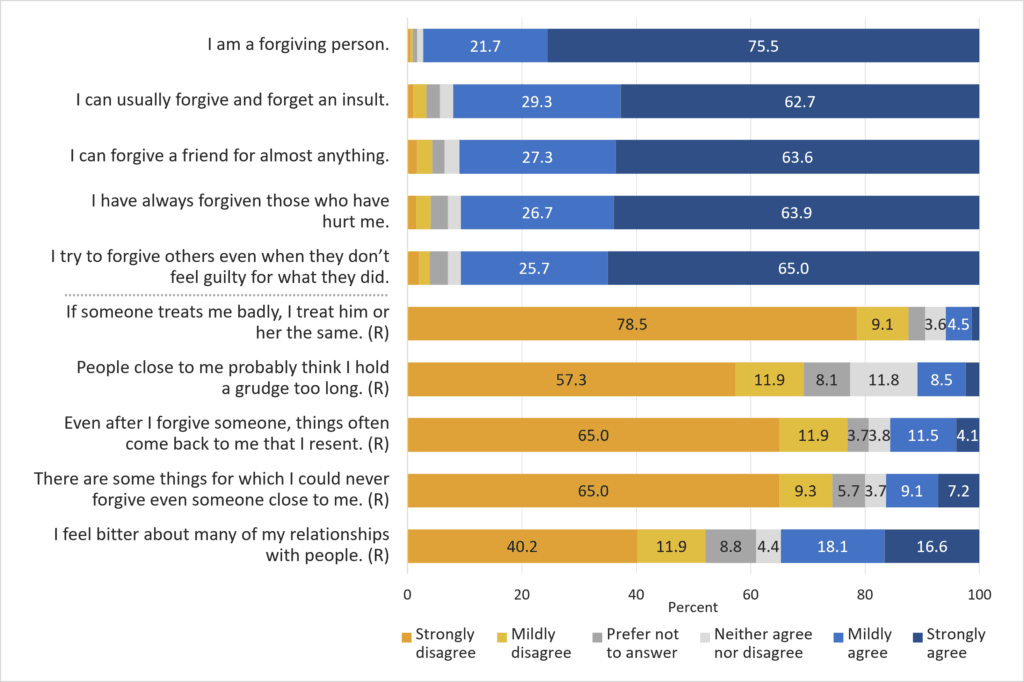
Chart Summary
The stacked horizontal bar chart displays 10 items with percentages of 6 response options from strongly disagree to strongly agree. The positively worded items show high agreement. Combining strongly agree and mildly agree responses, 97.2% agreed with I am a forgiving person and 92.0% for I can usually forgive and forget an insult. In contrast, most disagree with the reverse scored items. Combining strongly disagree and mildly disagree responses, 87.6% disagreed that, if someone treats them badly, they treat them the same. Similarly, 76.9% disagreed with the statement that even after they forgive someone, things often come back to them that they resent. These findings appear in Section 4 of the report.
Figure 4.2, Divine Forgiveness Scale, Percentages of Responses by Item
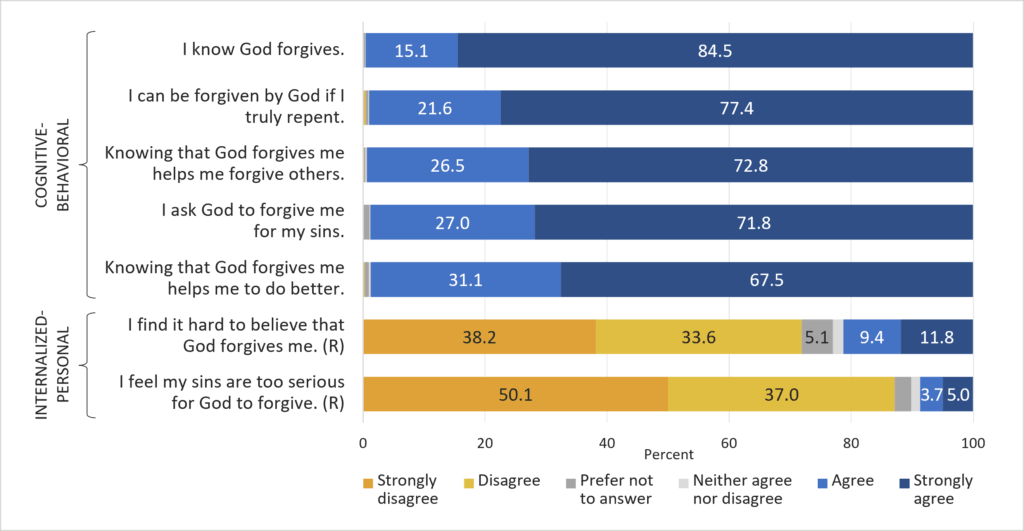
Chart Summary
The stacked horizontal bar chart shows percentages of responses to items in 2 categories: Cognitive Behavioral and Internalized Personal. The 6 response options range from strongly disagree to strongly agree, with prefer not to answer and neutral options. The 5 cognitive behavioral items show very strong agreement. Combining strongly agree and agree responses, over 99% agree that they know God forgives, they know they can be forgiven if truly repentant, and knowing God forgives them helps them forgive others. In contrast, the two Internalized Personal reverse scored items show dominant disagreement. Combining strongly disagree and disagree responses, 71.8% disagree with the statement, I find it hard to believe that God forgives me, and 87.1% disagree with the statement, I feel my sins are too serious for God to forgive. These findings appear in Section 4 of the report.
Figure 4.3, Self-Forgiveness Dual-Process Scale, Percentages of Responses by Item
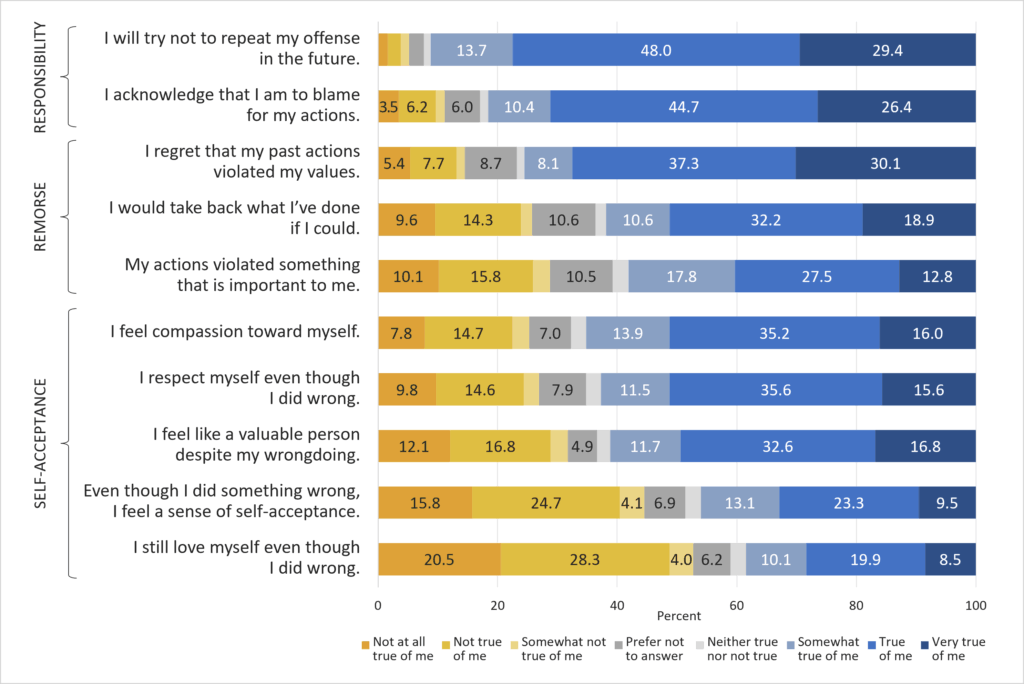
Chart Summary
The chart shows stacked horizontal bars reporting percentages for 10 items from the Self-Forgiveness Dual Process Scale. The items are grouped into 3 categories: Responsibility, Remorse, and Self-Acceptance. The 8 response options are: not at all true of me, not true of me, somewhat not true of me, prefer not to answer, neither true nor not true, somewhat true of me, true of me, and very true of me.
The 2 items in the Responsibility category show strong agreement. For the statement, I will try not to repeat my offense in the future, 29.4% responded very true of me, 48.0% responded true of me, and 13.7% responded somewhat true of me, to a total of 91.1%. For the statement, I acknowledge that I am to blame for my actions, 26.4% responded very true of me; 44.7%, true of me; and 10.4%, somewhat true of me, to a total of 81.5%. Minimal disagreement is seen in this category.
The 3 items in the Remorse category also show general agreement. For the statement, I regret that my past actions violated my values, 30.1% responded very true of me; 37.3%, true of me; and 8.1%, somewhat true of me, to a total of 75.5%. For the statement, I would take back what I’ve done if I could, 18.9% responded very true of me; 32.2%, true of me; and 10.6%, somewhat true of me, to a total of 61.7%. And for the statement, My actions violated something that is important to me, 12.8% responded very true of me; 27.5%, true of me; and 17.8%, somewhat true of me, to a total of 58.1%.
The 5 items in the Self-Acceptance category show more variation across the responses. Combining the 3 responses of very true of me, true of me, and somewhat true of me, the following percentages are calculated:
- 65.1% for the statement, I feel compassion toward myself.
- 62.7% for the statement, I respect myself even though I did wrong.
- 61.1% for the statement, I feel like a valuable person despite my wrongdoing.
- 45.9% for the statement, Even though I did something wrong, I feel a sense of self-acceptance.
- And 38.5% for the statement, I still love myself even though I did wrong.
In comparison, combining the not at all true of me and not true of me responses in the Self-Acceptance category, the 5 items range from 22.5% to 48.8%, with smaller somewhat true of me responses, all less than 4.1%. These findings appear in Section 4 of the report.