
The JW-RWA study provides insights into the meaning and manifestation of hope for Jehovah’s Witnesses. More than optimism or wishful thinking, hope includes a motivational state for dealing with life’s adversities. As a gauge of how positive and achievable the Witnesses believe their future goals and outcomes are, the study found a consistent positive temporal orientation among Jehovah’s Witnesses across age, gender, and Genocide experiences. The specific measure of hope included factors related to interconnectedness and positive readiness and expectancy, in addition to a future-oriented temporality. High scores of hope show little variation by age, gender, or Genocide experience. For Jehovah’s Witnesses in Rwanda, hope and faith appear integral, as reflected in the uniformity of positive hope responses across different measures and among the various socio-demographic groups. (Hope in Section 6, page 364)
Jehovah’s Witnesses attribute their hope to their religion, with 97% reporting that their hope for the future improved since becoming Witnesses. (Figure 6.25)
Hope for the future is one of the leading reasons individuals decide to become Jehovah’s Witnesses. (Figure 3.4)
A key doctrinal teaching rooted in hope is the core belief that God’s Kingdom will remedy all human suffering. The teaching about the Kingdom underpins the principles of nonviolence and political neutrality. These foundational principles may lie at the heart of individual Witnesses’ ability to face harassment, repression, and violence with a principled resolve to respect life.
Figure 6.25, Perceived Change in Subjective Wellbeing Since Becoming One of Jehovah’s Witnesses
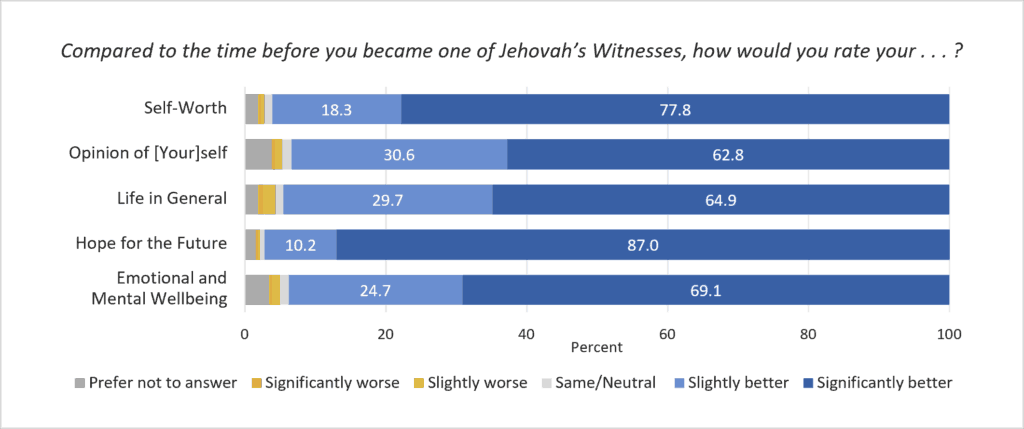
Chart Summary
The stacked horizontal bar chart shows how respondents rated changes in 5 aspects of subjective wellbeing since becoming Jehovah’s Witnesses: self-worth, opinion of self, life in general, hope for the future, and emotional and mental wellbeing. Rating ranges from significantly worse to significantly better. Across all categories, improvement dominates: for self-worth, 18.3% report slightly better and 77.8% significantly better; for opinion of self, 30.6% report slightly better and 62.8% significantly better; for life in general, 29.7% report slightly better and 64.9% significantly better; hope for the future, 10.2% report slightly better and 87.0% significantly better; and for emotional and mental wellbeing, 24.7% report slightly better and 69.1% significantly better. Overall, trends show improvement across the 5 items related to wellbeing, especially in hope for the future, representing the highest improvement. These findings appear in Section 6 of the report.
Figure 3.4, Original and Current Attractions to Jehovah’s Witnesses
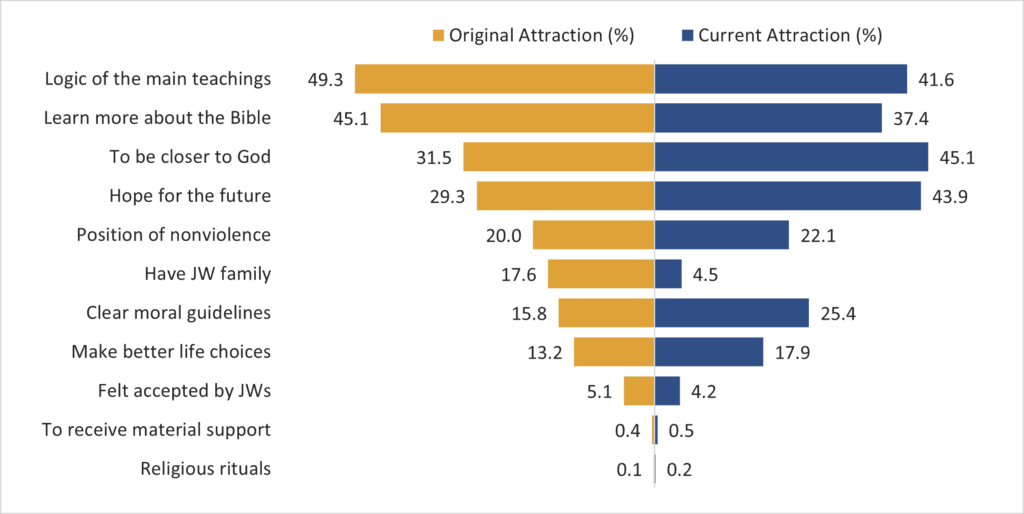
Chart Summary
The chart presents horizontal bars comparing percentages for original attraction versus current attraction to Jehovah’s Witnesses across 11 motivations, with original and current attraction each on its own percentage scale. The strongest original attractions are the logic of the teachings at 49.3% and learning more about the Bible at 45.1%, whereas current attraction is highest for closeness to God at 45.1% and hope for the future at 43.9%. Several attractions show increases over time. They include:
- Clear moral guidelines, from 15.8% originally to 25.4% currently.
- Making better life choices, from 13.2% originally to 17.9% currently.
- Closeness to God, from 31.5% originally to 45.1% currently.
- And hope for the future, from 29.3% as an original attraction to 43.9% as a current attraction, all of which show clear upward shifts.
Other categories remain relatively level or decline, such as the Witnesses position of nonviolence, which rises modestly from 20.0% to 22.1%. Having JW family as an original attraction drops sharply from 17.6% to 4.5% as a current attraction. Motivations chosen the least often as either original or current were those attracted in order to receive material support and those attracted to religious rituals, both at a half percent or less. These findings appear in Section 3 of the report.