
In the early 1980s, government opposition to Jehovah’s Witnesses for their position of nonviolence and political neutrality culminated in the imposition of a nationwide ban on the religious community and their activities. During the decade-long government ban, individuals demonstrated personal commitment to their principles by conscientiously refusing political and military involvement, such as by not making political donations, wearing political emblems, participating in patriotic celebrations, or serving in the military. Adhering to their religious principles resulted in persecution and harassment—banned meetings, school expulsions, house raids, arrests, imprisonment, and physical violence. During this period, Witnesses’ adherence to shared core values and mutual support even under repressive coercion and violence built and strengthened a religious network of trusted individuals. (Figure 3.11)
Figure 3.11, Religious Persecution Jehovah’s Witnesses Experienced During Legal Ban, 1982–1992
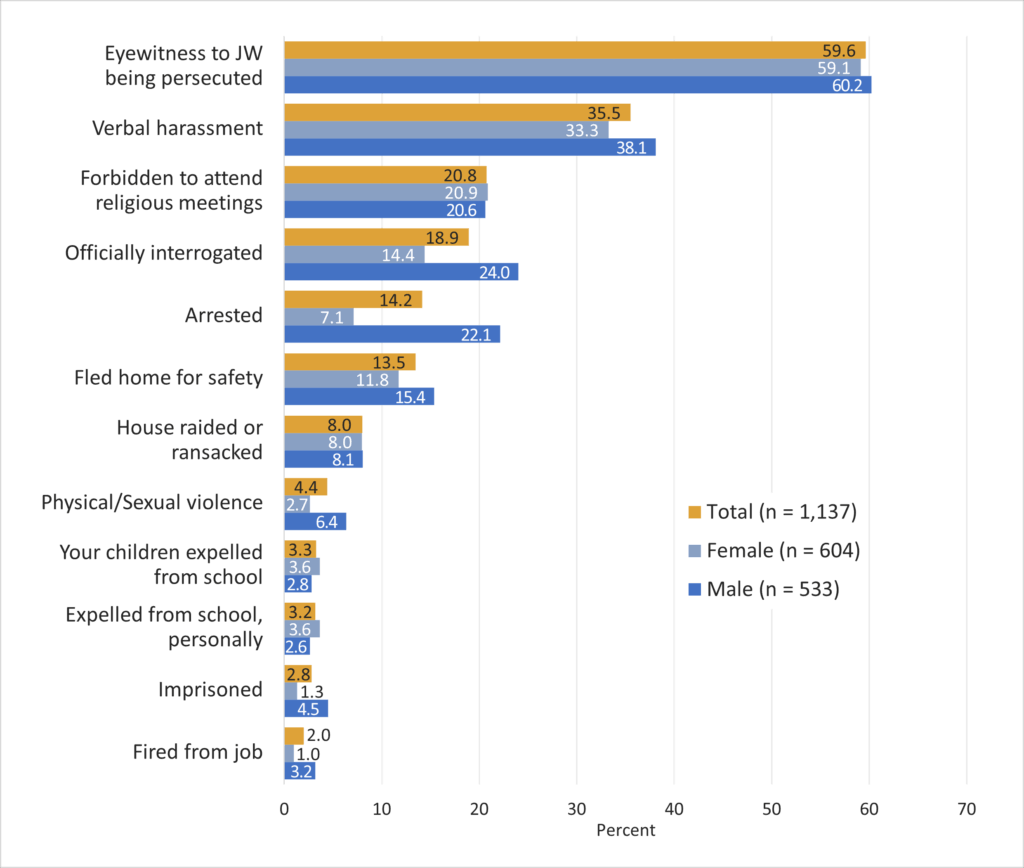
Chart Summary
The horizontal bar chart shows percentages of respondents who experienced 1 or more of the 12 forms of persecution listed. Each set of clustered bars represents 3 groups: total sample (both males and females) of 1,137 respondents; the second and third groups represent 604 females and 533 males, respectively. The most common experience at 60% for all 3 sample groups was being an Eyewitness to Jehovah’s Witnesses being persecuted. Males experienced Verbal harassment slightly more than females, averaging to 35.5% for the total sample. Both males and females were equally Forbidden to attend religious meetings at about 21%. Other midrange experiences, which include Being officially interrogated, Arrested, and Fled home for safety, were reported at notably higher percentages by males than females, with a range of 13.5 to 18.9% for the total samples. House raids or ransacking were reported equally by both males and females at 8.0%. Regarding Physical or Sexual violence, 6.4% of males reported experiencing this type of persecution, more than twice that reported by females at 2.7%. The final 4 forms of persecution listed include: Your children expelled from school, Expelled from school personally, Imprisoned, and Fired from job, all with totals of about 3% or less for these less common but difficult experiences. These findings appear in Section 3 of the report.