Just two years after the government ban on Jehovah’s Witnesses was lifted in 1992, the Genocide against the Tutsi further tested their principled position of nonviolence. According to organization records, Jehovah’s Witnesses and their close associates (family and Bible students) numbered about 2,500 in Rwanda by 1994, with an estimated 400 deaths of Witnesses and their close associates during the Genocide.
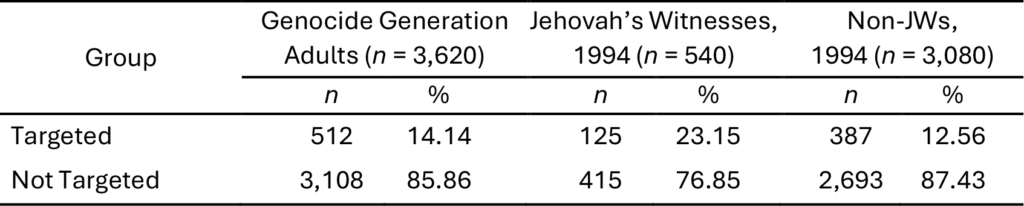
The study had 661 respondents who were baptized Witnesses in or before 1994, which would account for approximately 25% of the baptized JW population in 1994. Jehovah’s Witnesses record the number of publishers (those who share their beliefs with others) but do not keep demographic details (e.g., age, gender, ethnicity). In the JW-RWA study, the percentage of baptized Jehovah’s Witnesses in 1994 who were targeted to be killed (presumed to be Tutsi) was higher than those targeted who were not Jehovah’s Witnesses in 1994 (23% compared with 13%). That means that almost one fourth of the small marginalized faith community was targeted to be killed for being Tutsi, and their non-Tutsi fellow believers could have been killed if caught hiding or helping Tutsi. (Table 5.4)
Table 5.4, Targeted and Not Targeted During the Genocide Against the Tutsi, Jehovah’s Witnesses and Non-JWs