
Intergenerational conversations about the Genocide against the Tutsi are recognized as being both difficult and beneficial for those telling and hearing experiences. Over three fourths of Jehovah’s Witnesses reported that young and old in their family are open to conversations about traumatic experiences and that young can learn from their family’s history but should respect those who prefer not to discuss past traumas. Statements related to the emotional impact of conversations about the Genocide were more difficult to answer, with mixed responses. About half recognized that such conversations can provide moral lessons but can also be painful. About one third thought such conversations can do more harm than good and that children should not be burdened with others’ past traumas. However, only one out of ten indicated that they were “tired” of talking about the Genocide. (Figure 6.8)
The emotional impact of Genocide stories was felt by young and old but was strongest among older adults. (Figure 6.9)
Those with either direct or familial Genocide experiences associated pain with talking about the Genocide, especially for individuals who were personally targeted or had their family targeted to be killed. (Figure 6.10)
Over 80% of Jehovah’s Witnesses are comfortable discussing traumatic events with family, those in the congregation, and with individuals of similar ages and backgrounds. (Figure 6.3)
Conversations about personal or familial Genocide experiences are mostly limited to those in one’s immediate family and congregation. Compared with the Genocide Generation and Returnees, the Post-Genocide Generation is less likely to have engaged in conversations about their family’s Genocide experiences. (Figure 6.5)
Figure 6.8, View of Intergenerational Conversations About Past Traumas and Genocide
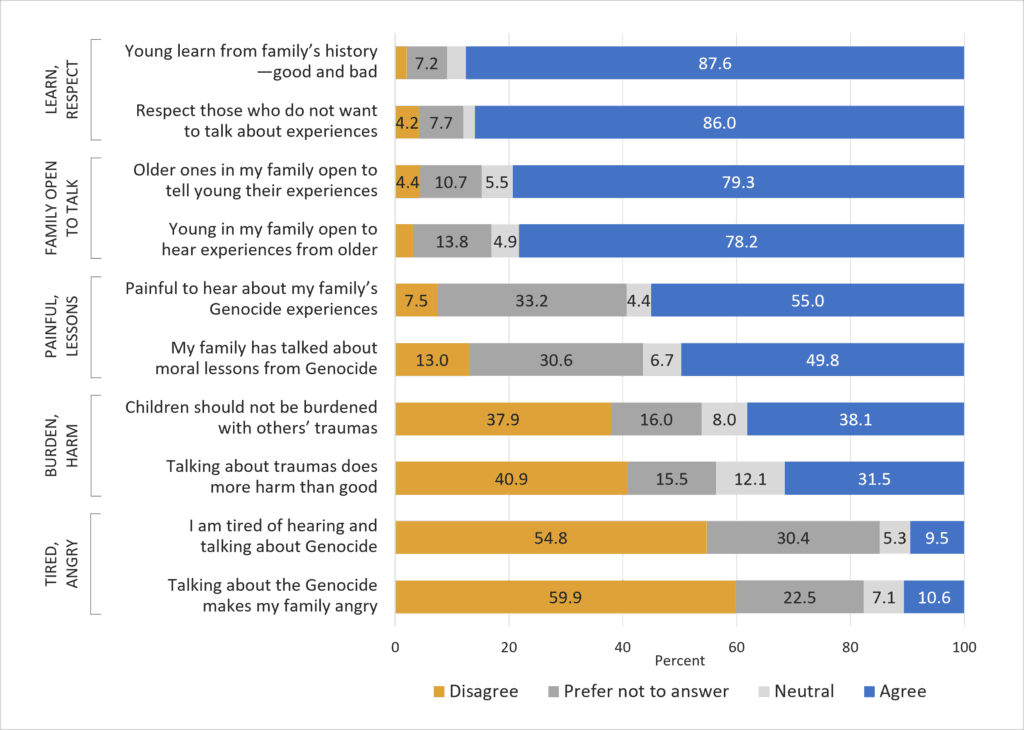
Chart Summary
The horizontal bar chart shows percentages for 10 statements about intergenerational conversations on past traumas and the genocide, grouped under 5 themes: Learn/Respect, Family Open to Talk, Painful/Lessons, Burden/Harm, and Tired/Angry. Response categories included disagree, prefer not to answer, neutral, and agree. Under Learn/Respect, agreement is very high: 87.6% agree that young people learn from family history and 86.0% agree that those unwilling to talk should be respected. Under Family Open to Talk, agreement remains strong: 79.3% believe older family members are open to sharing their experiences, and 78.2% believe younger ones are open to hearing experiences. Under Painful/Lessons, patterns are more mixed: 55.0% agree it is painful to hear about family genocide experiences, while 49.8% agree the family has discussed moral lessons, with moderate neutral and few prefer not to answer responses for both statements. Under Burden/Harm, responses are more closely matched: 37.9% disagree with the statement that children should not be burdened, and 40.9% disagree that talking about traumas does more harm than good, with moderate neutrality and slightly lower agree responses. Under Tired/Angry, disagreement is highest: 54.8% disagree with being tired of hearing about the genocide and 59.9% disagree that talking about it makes the family angry, with agreement below 11%. These lower agreement items contrast against the strong agreement with items related to learning, respect, and openness. These findings appear in Section 6 of the report.
Figure 6.9, Cognitive and Emotional Associations With Conversations About Past Traumas and Genocide by Age Group
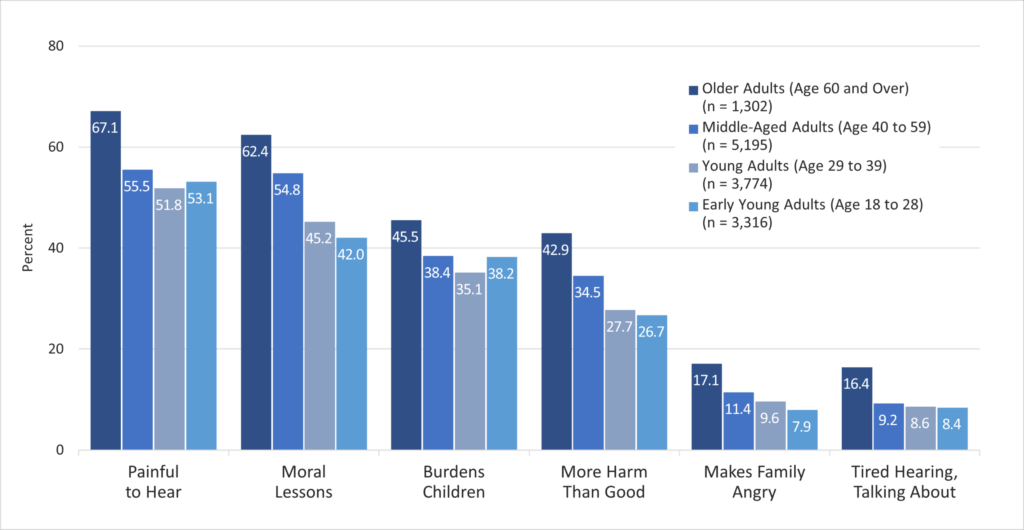
Chart Summary
The clustered vertical bar chart shows by age groups the percentage of agreement with each of 6 cognitive or emotional associations related to conversations about past traumas and the genocide. The 4 age groups are: older adults (age 60 and older, n = 1,302), middle-aged adults (40 to 59 years of age, n = 5,195), young adults (29 to 39, n = 3,774), and early young adults (18 to 28, n = 3,316). The 6 cognitive and emotional associations are: painful to hear, moral lessons, burdens children, more harm than good, makes family angry, and tired of hearing or talking about it. Painful to hear is highest among older adults at 67.1%, followed by moral lessons at 62.4%. The item Burdens children shows moderate levels across all age groups. The item More harm than good declines with each younger group. Lower percentages (between 17 and 8% for all age groups) report that it makes their family angry or that they are tired of hearing or talking about it. These findings appear in Section 6 of the report.
Figure 6.10, “Painful to Hear About Family Genocide Experiences” by Distinct Role-Situations Across Generations
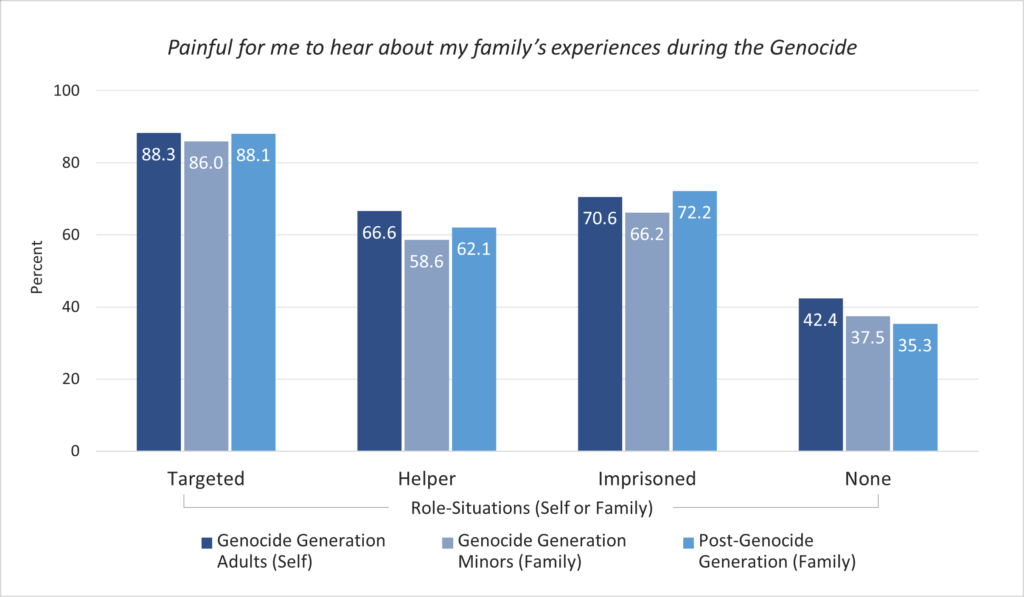
Chart Summary
The clustered vertical bar chart presents 4 Genocide role‑situation categories indicating either the respondent’s own role during the Genocide or their family’s role: Targeted, Helper, Imprisoned, and None. Three bars appear side by side per role-situation, representing generational groups: Genocide Generation Adults, Genocide Generation Minors, and Post‑Genocide Generation. The chart displays the proportion of respondents who agree that hearing about their family’s experiences during the Genocide is painful. The highest rates appear among those in the Targeted category: 88.3% for Genocide Generation Adults, 86.0% for Genocide Generation Minors, and 88.1% for Post‑Genocide Generation. In the Helper category, the percentages are substantial levels of agreement: 66.6%, 58.6%, and 62.1%, respectively. The Imprisoned category shows moderately high agreement, with 70.6% for Genocide Generation Adults, 66.2% for Genocide Generation Minors, and 72.2% for Post‑Genocide Generation. The None category shows the lowest levels, where levels drop to 42.4% for Genocide Generation Adults, 37.5% for Genocide Generation Minors, and 35.3% for the Post‑Genocide Generation. Overall, trends show that pain associated with hearing about genocide‑related family experiences is widespread across generations, with the highest levels among those who were targeted or imprisoned. These findings appear in Section 6 of the report.
Figure 6.3, Comfortable Talking to Others About Traumatic Events
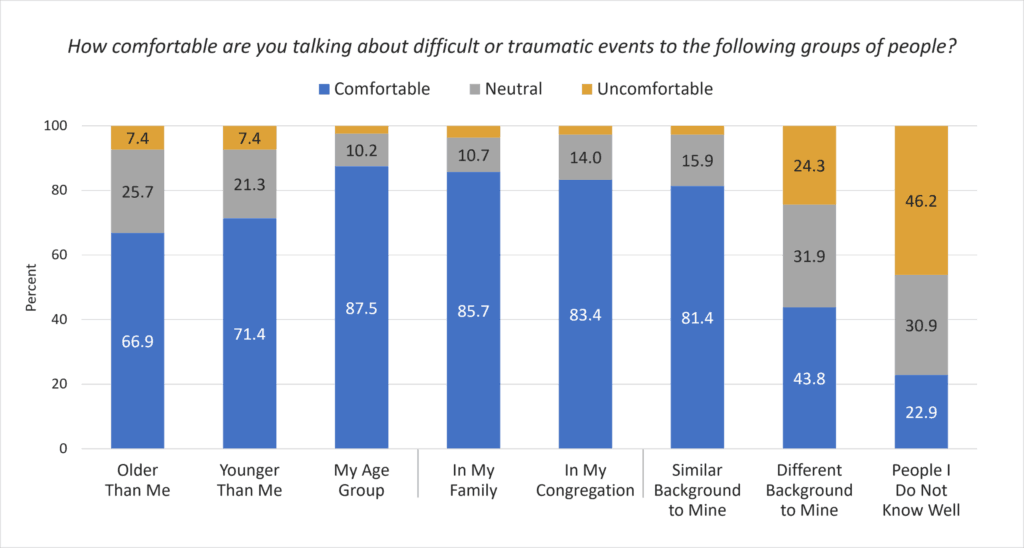
Chart Summary
The stacked vertical bar chart shows responses to the question: How comfortable are you talking about difficult or traumatic events to the following groups of people? Respondents reported comfort levels—categorized as comfortable, neutral, or uncomfortable—across 8 groups of people. The highest responses for comfortable are with those in their age group at 87.5%, in their family at 85.7%, in their congregation at 83.4%, and those sharing a similar background at 81.4%. For these groups, less than 4% reported feeling uncomfortable. Moderately high comfort levels appear for those younger than them at 71.4% and older than them at 66.9%. Lowest responses for comfortable appear for those with a different background at 43.8% and people not known well at 22.9%. For these latter groups, uncomfortable responses rise significantly—24.3% and 46.2%, respectively—while neutral responses made up about 30% for both. These findings appear in Section 6 of the report.
Figure 6.5, Dialogue About Personal or Family Genocide Experiences by Generation Cohort
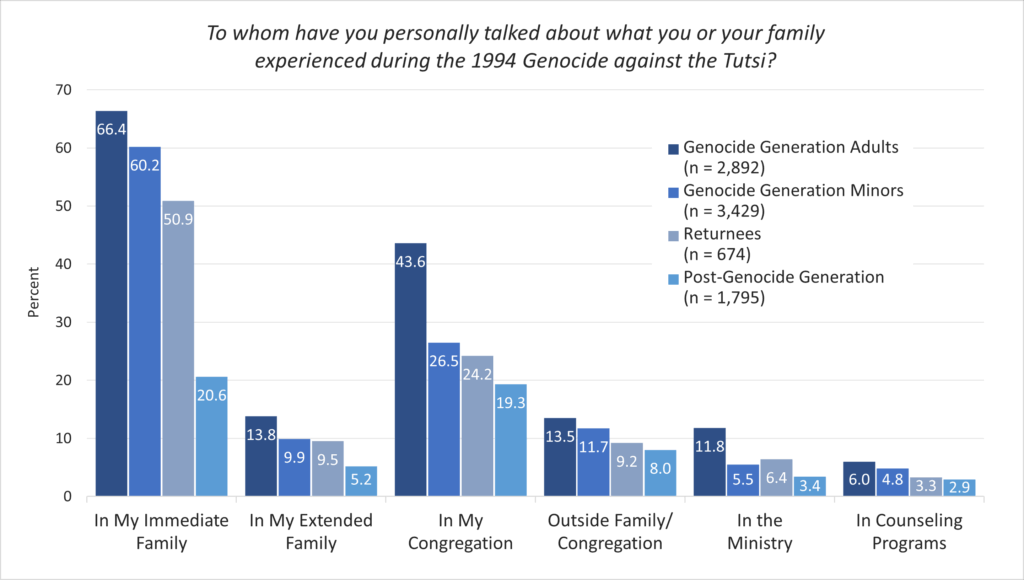
Chart Summary
A clustered vertical bar chart showing 6 conversation groups and the percentages of respondents who personally spoke with them about their genocide experiences. Respondents are separated into 4 cohorts: Genocide Generation Adults (n = 2,892), Genocide Generation Minors (n = 3,429), Returnees (n = 674), and the Post-Genocide Generation (n = 1,795). Talking within the immediate family is most common across cohorts, highest among Genocide Generation Adults at 66.4%, followed by Genocide Generation minors at 60.2% and returnees at 50.9%, with post-genocide respondents at 20.6%. Extended family conversations are low across groups with 13.8% for adults, 9.9% for minors, 9.5% for returnees, and 5.2% for post-genocide generation. Talking in the congregation is the second-highest overall, led by adults at 43.6%, with minors at 26.5%, returnees at 24.2%, and post-genocide respondents at 19.3%. Talking outside family or congregation shows smaller values (13.5% adults, 11.7% minors, 9.2% returnees, 8.0% post-genocide respondents), as do ministry conversations (11.8% adults, 5.5% minors, 6.4% returnees, 3.4% for the post-genocide generation). Counseling programs show the lowest levels across all cohorts, with 6.0% for adults, 4.8% for minors, 3.3% for returnees, and 2.9% for post-genocide respondents. These findings appear in Section 6 of the report.