
The perceived effects of the Genocide on respondents’ worldview, family narratives, and personal outlook are greater among those who experienced the Genocide as adults or minors than for Returnees and the Post-Genocide Generation. Overall, for the total sample, 61% indicated the Genocide affects how they think and feel about the world; 50% often think about its effect on their own lives; and 36% feel it is central to their family’s life story. (Figure 6.16)
Figure 6.16, Centrality of Genocide, Percentages for Total Sample
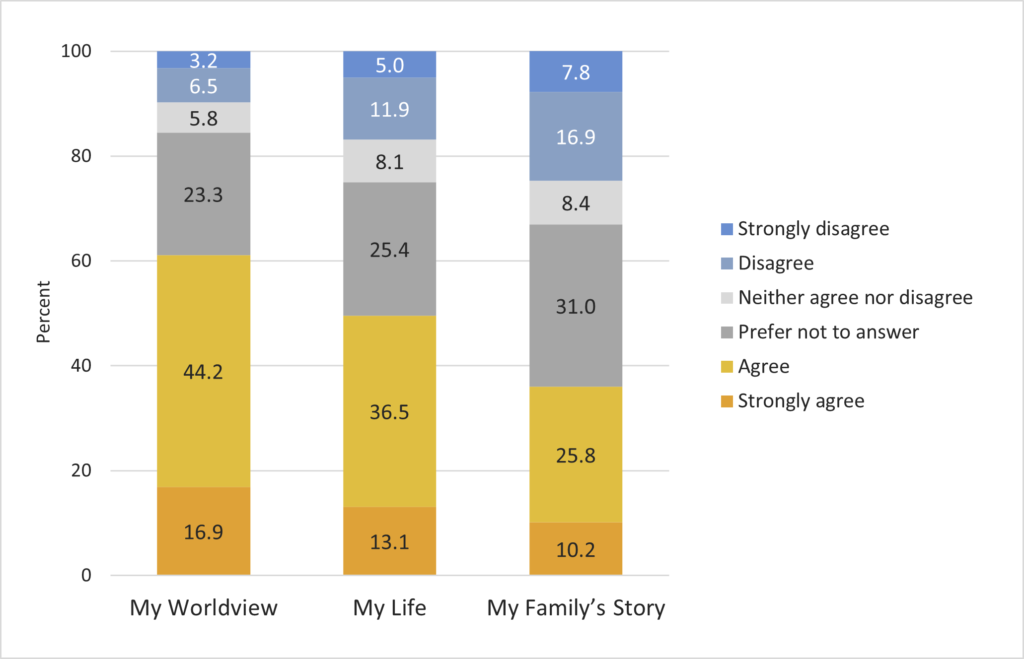
Chart Summary
The 3 stacked vertical bars show percentages for how central the genocide is to respondents’ worldview, life, and family’s story. Each bar is segmented into 6 response options: strongly disagree, disagree, neither agree nor disagree, prefer not to answer, agree, and strongly agree.
- Of the 3 categories, respondents reported the strongest effect was felt on their worldview, with 61.1% agreeing that the genocide affected how they thought and felt about the world, including 44.2% agreeing and 16.9% strongly agreeing. This is followed by 23.3% preferring not to answer and 5.8% neutral in their response. Smaller disagree segments show that 6.5% disagree and 3.2% strongly disagree.
- As it pertains to the genocide’s effect on their own life, agreement remains substantial but somewhat lower, with 36.5% agreeing and 13.1% strongly agreeing. For this life category, 25.4% preferred not to answer and 8.1% chose to neither agree nor disagree, with small disagreement bands displaying.
- Respondents’ view of the genocide’s effect on their family’s story vary widely: 25.8% agree, 10.2% strongly agree, with 31% reporting that they prefer not to answer. The larger disagreement segments follow with 16.9% disagreeing and 7.8% strongly disagreeing, with 8.4% choosing neutral, neither agreeing nor disagreeing.
These findings appear in Section 6 of the report.